
How to Start Reselling in 2026: A Complete Beginner's Guide

From total noob to seasoned pro, we're here to answer all your questions

Beginners Guide to Reselling Flipping 2026

Key Points

  • At its core, reselling is straightforward and generally lucrative

  • Most resellers find sourcing products is the biggest bottleneck on their profits

  • Joining an established network of likeminded resellers is a fast track to quick success

With 2026 well under way, making a little extra money on the side might be on your mind right now. Reselling items for a profit is one of the most lucrative side hustles out there, and requires very little experience or upfront capital to start making real money. This guide will walk you through the basics of the entire process, from establishing your seller accounts and navigating eBay, to sourcing products for your first flip, how to ship your sales, and reinvesting those profits into more opportunities. Even if you’re just looking for a few casual flips here and there, reselling is a consistent way to add real money to your income.

What is Reselling? Is it Profitable?

Reselling is buying products at one price and selling them at a higher price, pocketing the difference after fees and shipping. That’s the whole model. The categories and sourcing methods vary widely, but the underlying logic never changes.

It’s no different from running any business. As long as the money you get out of it is higher than the money you put into it, you’re in the clear. Compared to other side hustles, reselling is uniquely low-effort. Many resellers clear huge profits entirely through online purchases and sales from their phone during a lunch break. Others pick up items directly from retailers to list them online at a higher price.

And while there are some misconceptions about the idea, reselling is completely legal. The First Sale Doctrine, established in 1854, affords Americans the unalienable right to sell items they legally own, for whatever price they want. We also occasionally come across people accusing resellers of “price gouging,” which is a real term with a real definition. Price gouging is charging an inflated price for an essential good during an emergency. Selling food and water for hundreds of dollars during a hurricane is price gouging, scalping Taylor Swift’s fans for limited edition CDs is not.

Speaking of which, you might be wondering how much money resellers can actually make? Like most things in life, it depends on how much you’re willing to put into it, and what kinds of items you’re flipping. Some people have successfully made reselling their full time job, but they’re definitely exceptions. Instead, most will treat reselling as an additional income stream in addition to a day job, or as a way to earn some cash as a student or homemaker.

RC Enabled me to quit 2 dead end jobs, earn a living, and spend time with my family. The best part is paying forward. Over Thanksgiving I was able to donate over 40 turkeys to families in need because of a lead in RC.

@JGray, RC Elite member since 15 Feb, 2021.

Most resellers will usually start small, but it’s not unreasonable to expect to make a few hundred dollars per month by flipping. One thing you need to understand upfront is that reselling is very unpredictable. Unlike other businesses, you generally don’t have reliable sources of products to sell. You are hunting for price errors, deep discounts that don’t last long, and limited edition products that sell out in minutes – sometimes seconds. One of the most important traits for a reseller is speed; you need to make decisions quickly and confidently, before other people do.

You might have weeks or even months with very little activity with just a few small flips here and there, and then you might have a single flip that’s more profitable than everything you’ve sold in the last 12 months. This is not hyperbole. Since 2026 has started, we’ve already tracked two opportunities for resellers to make tens of thousands of dollars from a single flip. (At the time we published that One Piece article, those trading cards were worth over $100,000.)

In between these huge flips are the small ones. A little less glamorous, a little less profitable, yes, but when you’re pocketing $10, $20, $50, or $100 bills on quick flips every day, that money adds up fast. We’re never going to advertise reselling as a fail-proof, get-rich-scheme that works for everyone because it’s not. But for the average person looking to add a little extra money to their wallet with minimal effort? This is about perfect.

What Kinds of Items Resell?

There are two primary limitations to how much money you can make reselling: the items you’re flipping, and the amount of money you have to invest. These factors are on a two-way street where one affects the other. If you’ve only got $100 to start with, then that puts most high ticket items off the table; conversely, if you’re only buying and selling inexpensive stuff, your potential profits will usually be much lower (but not always, more on that in a second).

Let’s start with the products themselves, and discuss “niche” resellers vs. “general” resellers.

A niche reseller is the type you might already be familiar with; think sneakerheads and hypebeasts collecting and reselling designer shoes and clothes, or Pokemon fanatics exclusively dealing in sealed cases and slabbed cards. Many niche resellers straddle the line between collector and flipper. They were probably already heavily invested in their hobby, and began leveraging their deep knowledge to resell items for a profit.

A general reseller is operating with a “profit first” mindset. They don’t care what they’re buying and selling, they just care if it will make them money. Popcorn buckets, graphics cards, PlayStation controllers, skateboards, signed CDs. The only thing these items have in common is they all resell for much more than they retailed for.

This website and RC Elite, our members-only paid Discord, are geared around this “general” reseller method. While we do partner with experts in particular niches like sneakers and trading cards, our general philosophy is focused on flexibility and diversity. Our aim is always to keep our eyes up, and evaluate every possible flip for profit. Sometimes that means we’re writing about rare kegs, dive bar-scented cologne, or vinyl records injected with human blood.

Let’s talk about some common categories that we see resellers banking profit on.

Reselling Collectibles

This is by far the most common and least specific of the niches we’ll cover. A collectible can be, honestly, almost anything. We’d define it as an item that people buy and own for no reason other than to buy and own it – it has no function, no use, no practical application, and even if it does have utility, that’s not why the owner keeps it.

This quirk of the human psyche, our urge to hoard and collect, is the same quirk resellers exploit to reap huge profits on collectibles. After all, if you’re already willing to pay $100 for a toy or a coin or a signed baseball, what difference is another $100? Once you have enough collectors competing over the same product, these numbers can stretch into the $1,000+ range as someone will eventually hit a critical mass of FOMO and poor budgeting to trigger the sale.

When hunting for collectibles to resell, you need to evaluate supply and demand. Collectibles are generally limited edition items that do not restock, which makes them perfect for reselling. Look for hard production numbers. Are they only making 1,000 of an item? Are they individually numbered? And are there enough fans or collectors of this IP/sports team/TV show/internet celebrity to guarantee the item will sell out and flip for a profit? We’ve broken the concept down in more detail in our guide to the best items for beginners to flip.

Reselling Trading Cards

There’s a reason everyone around you has been going feral for Pokemon cards the last few years, and it’s money. Since the start of the pandemic, we’ve tracked an explosion of interest in the card-collecting hobby. This has mostly been centered around Pokemon, but other TCGs like Magic: The Gathering and Riftbound have seen similar spikes in sales. Sports trading cards have also exploded in popularity and are at their biggest levels in decades.

By and large, the bulk of profitable secondary sales for trading cards are sealed product. This means the cards inside the box have not been opened and, theoretically, there might be a card or cards inside the box that are valuable. So valuable that they more than pay off the price of the box from a retailer, and maybe even valuable enough to justify buying one from a reseller. It’s the same psychology that drives slot addicts to whittle away their time and money in casinos, neatly packaged for children of all ages to enjoy. Resellers profit from selling these trading card packs at a significant markup, although finding sealed product at retail has gotten more difficult as the hobby grows.

Reselling Watches

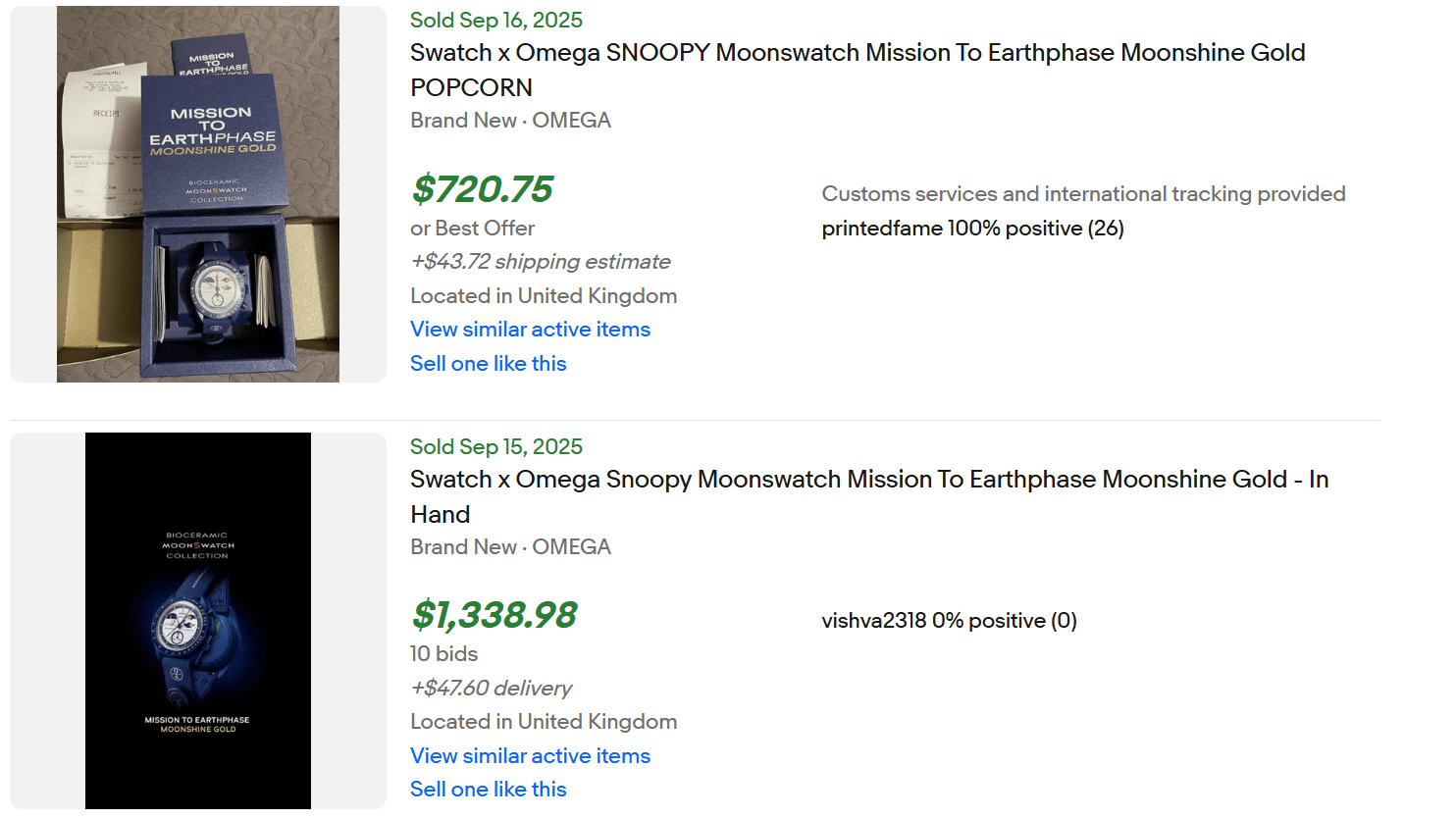
Hang on, wasn’t this supposed to be a beginner’s guide? What beginner has the kind of cash to flip a Rolex? Believe it or not, there are actually plenty of more affordable watches that will sell out at retail and go on to flip for a profit. We’re still talking in the $500 to $1,500 range, but nowhere near the tens of thousands you might expect when you hear “collectable watch.”

Swatch is the big name in this category, and we tracked resellers raking in tons of profit from their MoonSwatch collaboration with OMEGA in 2024 along with their Dragon Ball Z collab in 2023.

Swatch Gold Snoopy Earthphase for Sale

Of course there are also profits to be found on the higher end of the watch spectrum. Buying, selling, and collecting watches has served as a status symbol and mark of taste for decades, and it will continue to be a lucrative niche for resellers with the knowledge and money to invest in the market.

How to Start Reselling

There are obviously far more examples of profitable items to flip than we can cover in this overview. Let’s take a moment to walk back and examine what is actually required to begin reselling items for a profit, assuming you have no experience and no idea of what the hell you’re doing. We all started somewhere.

First, we need to establish a budget. We would generally advise starting with a few hundred dollars of money that you can afford to lose. It would be dishonest to act like reselling is a risk-free enterprise, although we make an effort to protect our readers by vetting potential flips and including disclaimers about risk. If $100 is what you have to work with, that will be fine. So is $1,000. Either way, you’re going to need some starting capital. Having some credit to work with is ideal. While you might not be able to start slinging around cash if you’re just getting started, using a credit card allows you to chase limited edition flips before they sell out, then use the profit to pay off your balance. We’ve written a more comprehensive guide to leveraging credit here.

You’ll also hear us harping about why return and refund policies are so important for resellers. This is something we see many beginner resellers ignore or underestimate to their own detriment. At best, you’re leaving money and potential flips on the table. At worst, you could get burned and waste your money on an item you can’t flip and can’t return.

Why Return Policies are So Important

  • If you can return your item, it becomes a zero-risk flip

  • No risk means more confidence; you can afford to load up on an item

  • This multiplies your profits if the flip is successful

  • And if not? Take your item(s) back to the store for a full refund

How to Start Selling on eBay

Once you’ve spent your money on an item, it’s time to get it back (and hopefully more) by listing it for sale. Now, there are a lot of sales platforms out there, and we’ve produced a thorough breakdown that examines and compares your options.

That said, almost all of your listing and selling will be done through eBay. Why? Because it’s the largest global sales platform, by far. More users = more eyes on your listings = more sales, and hopefully more profit. Setting up an eBay account and making your first listing is easy.

Getting started, you’ll find that eBay sets limits on new accounts. These thresholds increase quickly, but it does mean you’ll be limited to a handful of sales early on. We recommend beginner resellers to make an effort to list multiple items in this early period, even if your potential profits are low. This will help build your eBay feedback and hone your core reselling skills like shipping items, learning how to price your items effectively, and making presale listings for items that haven’t shipped yet, as well as handling negative feedback and disputes that are an unfortunate aspect of the business.

Platform fees are an important consideration. eBay fees are incurred based on the type of item you’re selling and its final sale value. These can reach up to 15% or as low as 9%, but the vast majority of your sales will have a fee of around 13.6%. Mercari offers slightly lower fees, while StockX utilizes a sliding fee schedule with established sellers paying smaller fees.

Shipping is also a critical factor. Even your smallest packages will run around $5, and that number can quickly balloon as size and weight increase. Make sure you read our full guide to shipping on eBay, and consider selling your items locally through Facebook Marketplace or similar platforms to sidestep platform fees and shipping costs.

Finally, we strongly recommend tracking your sales, even the early ones. This is an essential part of running any business effectively, and the data you gather will compound over time. We created a free spreadsheet for any reseller to use right here (make sure you click the “How to Use” tab for a quick explanation.)

Basics of an eBay Listing

  • Photos are nonnegotiable. Avoid stock photos unless absolutely necessary. Use multiple images

  • Target your keyword. Include the item’s full name in the title, along with other relevant info like color, variant, size, etc

  • Be honest. Include photos of damage, don’t misrepresent your item. eBay WILL side with the buyer in a dispute.

  • Fill out category and item specific fields, every time. These funnel additional buyers to your listing.

How Resellers Find Items to Flip

When evaluating whether an item is worth reselling, there are a few critical criteria. The most obvious is its price and the relevant supply and demand. As a rule of thumb, the more an item costs at retail, the more profit you can expect to reap on eBay. There are exceptions to this, of course, and we’ve covered items that retailed for under $100 flipping for up to $10,000, but the sticker price should always be front and center.

Typically, you’ll be listing an item above this retail price, but not always. We’ve covered several lucrative flips that relied on resellers picking up an item at a deep discount and reselling it at or below the usual MSRP. Not only is this a great deal for buyers, but it’s equally lucrative for sellers compared to their average flip. Spotting deep discounts and price errors is a crucial skill, especially as they usually disappear quickly.

Ideas for Quick Flips

Earlier, we mentioned that there were two main limits to your growth as a reseller: your own personal capital, and finding new items to flip. This is partly why certain categories like sneaker releases and trading card drops are so competitive and hard to purchase at retail; once everyone knows how potentially valuable they are, resellers and collectors all pile in on the same release, and the market gets tighter.

This is part of why we (Resell Calendar) put an emphasis on weirder, outsider flips and experimentation. The profits can be just as good or better than the established stuff, and competition is much lower. Almost all the flips we cover don’t need an expensive bot subscription, backdoor access, or camping out for hours for new product releases.

Unfortunately, finding these kind of flips on your own is difficult. Many of them require a degree of esoteric insider knowledge; you need to be familiar enough with an item, its relevant buyers, the drop details, pricing, and how similar releases have gone to begin doing the calculus on whether it’s worth flipping. This is why so many shoe resellers started as sneakerheads, or why TCG players go on to flip cards; they were already heavily invested and knowledgeable about their niche, and were able to spot the lucrative releases and skip the rest. Beginner resellers attempting to strike out on their own without this kind of background are at serious risk of getting burned. Sometimes for a little, sometimes for a lot.

This is why reselling communities, or cook groups, are so valuable. Resellers will pool their knowledge together to hunt and collate upcoming opportunities and new releases in search of profitable flip. Everyone is bringing something to the table, whether that’s sneaker expertise, insider information on an upcoming collectible release, or a deep discount on an expensive item. As the group and knowledge pool grows, so does its value to every individual member.

As you can probably guess, we operate one of these groups. Resell Calendar Elite is our paid, private, members-only Discord server. We’ve been operating for over seven years, returned millions of dollars in value to our members, and paid out over $1.2 million in bounties to people that have submitted tips to us.

No one likes a sales pitch, but the truth is that going it alone is hard. Unless you’re content to wait in online queues battling other resellers for the same stale flips, it can be a real challenge to break out and look for opportunities on your own. Joining a cook group, whether that’s RC Elite or someone else, is a fast track to lucrative flips and access to a community of experienced resellers. That kind of knowledge is invaluable when you’re just getting started and trying to avoid getting burned (there are a lot of ways it can happen.)

Growing Your Reselling Business

Once you have a few flips under your belt, it might be time to seriously evaluate what direction you want to take your business in. Want to keep it as a simple side hustle and pocket your profits? That’s completely fine, and many RC Elite members prefer the same approach. Rather than running around town trying to hit every little flip and scrape together an income, they prefer to wait around for the “big one” and invest heavily.

On the other side, we also have members that formed real, brick-and-mortar businesses off the backs of their reselling incomes. As your operations scale, it’s completely feasible to begin renting warehouse space, applying for reselling permits, even hiring employees to help out. But this is a beginner‘s guide, remember? We won’t be getting into that just yet.

It is important to note that resellers owe taxes on their businesses just like anyone else. While eBay is only required to report sellers with a combined volume of $20,000 or more in sales (and some states have lower thresholds), resellers are legally required to pay taxes on income that falls below this threshold. Fortunately, you are eligible to deduct your costs on these taxes, regardless of whether you’ve formally established a business or registered an LLC.

Speaking of which, we should talk a bit about LLCs. As resellers begin to solidify their profits, a common question is “Do I need an LLC for reselling?” The short answer would be no, not really. Many of the benefits you may associate with an LLC or “real” business like tax deductions or business credit lines are already available to you. Whether or not you realize it, you’re already running a reselling business and you’re entitled to everything that comes with it, regardless of an LLC.

Still, there are real benefits to creating one. The most obvious is in the name – Limited Liability Corporation. Opening an LLC creates a legal distinction between you and your business, protecting your personal assets in case of a lawsuit. We get into the details on our complete guide to resellers and LLCs here, but here’s the TL;DR: if you’re just getting started as a reseller, the paperwork can wait.

Bottom Line

Reselling really isn’t complicated. The name itself is a pretty succinct explanation of the process. The part that trips most beginners up isn’t the buying or the selling — it’s sourcing consistently. Finding profitable flips before the competition does is the skill that separates people who make real money from people who sold a few things once and moved on. That takes time to develop, and it develops faster with better information and a community around you that knows what they’re doing.

That’s exactly what RC Elite is built around. We’ve been running our members-only Discord for over seven years, surfacing opportunities across every category before they go mainstream, and the community has returned millions in value to members who’d rather spend their time buying than hunting. Membership is currently closed, but the waitlist is open. Limited restocks happen frequently with 24 hours notice ahead of time.

In the meantime, everything linked throughout this guide goes deeper on every topic we covered here. Start with whatever feels most relevant to where you are right now, make your first flip, and go from there.

Here is a complete list of all the guides, breakdowns, and sub-articles that supplement this guide:

Get posts like these in your inbox.

Monthly digest of the best of Resell Calendar.

Start Here

Beginners Guide to Reselling Flipping 2026
How to Start Reselling in 2026: A Complete Beginner's Guide

From total noob to seasoned pro, we're here to answer all your questions

Pounce on resell opportunities before they sell out.

Get the details

Beginners Guide to Reselling Flipping 2026
How to Start Reselling in 2026: A Complete Beginner's Guide

From total noob to seasoned pro, we're here to answer all your questions

Money sandwich, metaphor for cook group for resellers
What Is a Cook Group and Do You Need One?

Well, it's not a bunch of chefs hanging out

Subscribe to Newsletter

A monthly digest of the best of Resell Calendar.