

How to Price eBay Listings Without Leaving Money on the Table

Do your research, start high, and milk that FOMO

How to Price eBay Listings Profit

Key Points

  • Pricing too low out of the gate is a common and costly mistake beginner resellers make

  • Sold listings tell you what buyers actually paid, while active listings show you what the current market expects

  • Setting a higher price upfront gives the most options and opportunities to profit

The price you set for your eBay listings is the biggest factor behind your total profits. It’s important to be patient, realistic, and measured when setting and adjusting your price. Too many resellers are impulsive; quickly cutting prices when the item doesn’t sell. We’re going to break down the best practices for pricing eBay listings to ensure maximum profit and the buyer psychology that resellers can take advantage of.

Sold Listings vs. Active Listings

There’s a common piece of advice in reselling circles that goes something like “only look at sold listings, ignore active listings.” The idea is that active listings are just wishful thinking and only completed sales tell you what something is truly worth. That’s mostly correct, but it leaves out an important part of the picture.

Sold listings tell you what buyers have actually paid. Active listings tell you what sellers are currently asking. Both pieces of information matter. If you list a sneaker at $250 because recent sold listings show that range, but every active listing on the platform is sitting at $300, you’re robbing yourself of potential profit. If enough sellers adjust their pricing to match, you’ve created a lose-lose, race-to-the-bottom scenario for everyone.

Before you set any price, check both. On eBay, filter your search to “sold” to see completed transactions, then flip back to active listings to see where other sellers are starting. The spread between those two numbers is your working range. You want to start near the top of that range, not the bottom.

How to Check Sold eBay Listings

  • Make sure you’re logged into your account

  • On desktop, click “Advanced” next to the search button and filter for “sold” and “completed” listings

  • On mobile and app, search your item first then filter for “sold” listings

  • Alternatively, use 130point.com to search sold listings, including “best offer accepted”

Price High, Accept Low(er)

This is the core of a good pricing strategy, and it runs counter to the instinct most beginners have. When you’re looking at a product you just bought to flip, the temptation is to price it at or slightly below the lowest active listing to move it faster. The logic sounds reasonable, but it rarely plays out that way.

Here’s why pricing high works better. First, it keeps the market healthy. When every seller immediately undercuts the last, prices spiral downward and everyone loses. Second, and more practically, it gives you room to negotiate. eBay’s Best Offer feature exists for a reason. A buyer who won’t pay $300 might happily send you an offer for $260, and you’ve still come out ahead of the seller who listed at $240 trying to be the cheapest option in the room.

This strategy is especially effective for hyped items in the first 48 hours after a release. FOMO is real, and there will always be buyers who want something badly enough to pay a premium to get it immediately. If you price low on day one, you’ve already surrendered that upside. Set a number at the high end of the market, let it ride, and see what comes in.

Before You Lower Prices, Check Your Listing

A few days have passed and you haven’t gotten any bites. Your first instinct is probably to lower the price, and sometimes that’s the right call. But before you touch the number, take an honest look at the listing itself.

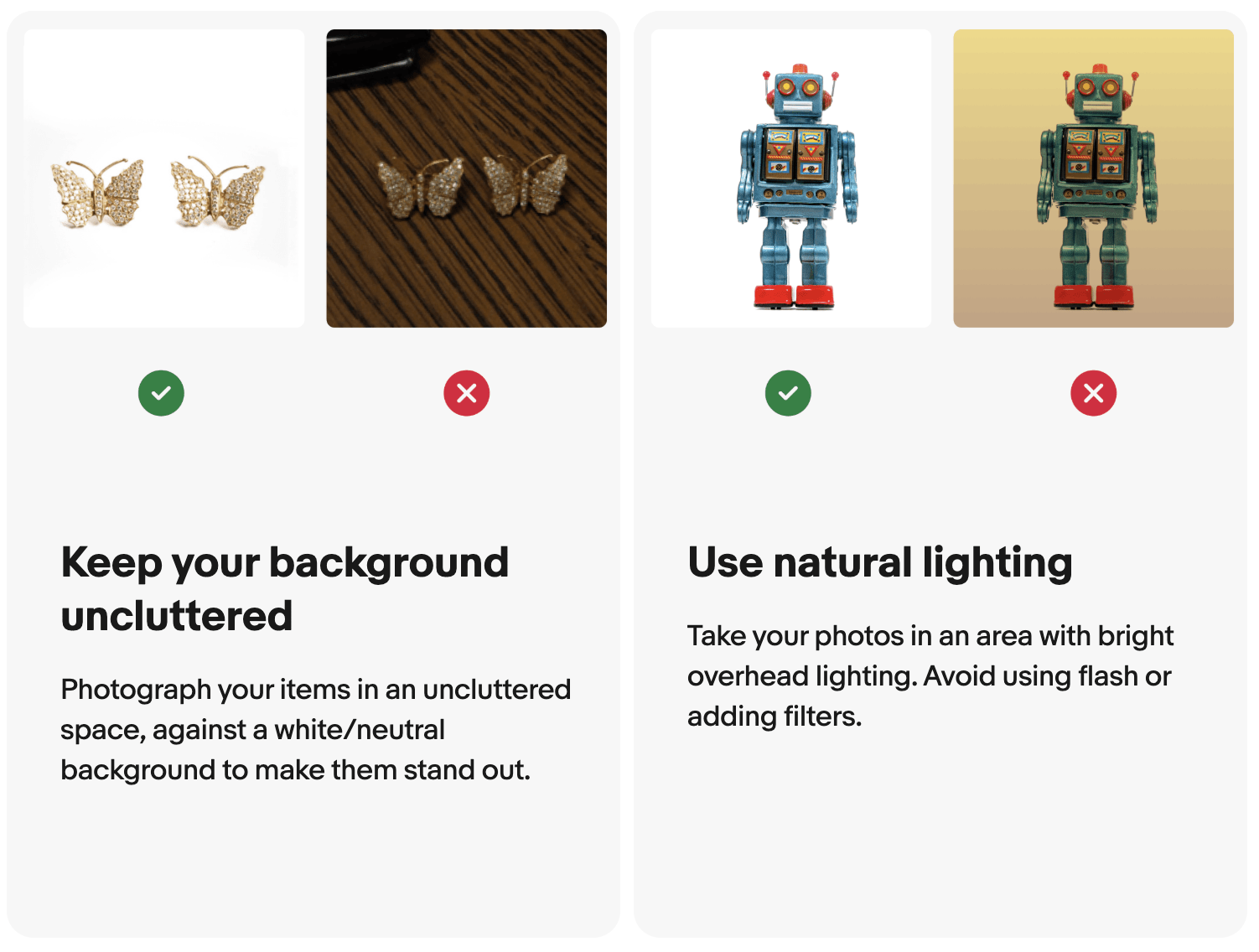
Photos are often the culprit. Buyers can’t hold the item, so your photos are doing all the work. Original, high-quality images shot against a clean background will outperform stock photos or blurry phone pictures every time. If other sellers have better photos than you do, that matters.

Comparison image of good and bad eBay photos

Your title is the other major variable. eBay’s search algorithm surfaces listings based on keywords, so a title that’s missing the product name, manufacturer, colorway, or other relevant descriptors will simply not show up in front of as many buyers. Pull up sold listings for the same item and compare their titles to yours. Are they using terms you aren’t? Broad keywords you’ve overlooked? Our guides on writing a strong eBay listing and eBay SEO basics cover both of these in detail and are worth a read before you make any pricing decisions.

Make sure that you’re filling in the item category and item specifics fields. These are critical for expanding your listing’s visibility beyond the search bar. Your item description should include the item’s full name, manufacturer, and any relevant keywords.

If your photos are solid and your title is tight, and you’re still not getting offers, then the price is probably the issue.

When and How to Adjust eBay Prices

Knowing when to lower your price is just as important as knowing not to do it too quickly. The answer depends almost entirely on your own situation and goals.

If you’re working with limited capital and need to free up money for the next flip, a more aggressive price drop makes sense. There’s no shame in taking a slightly smaller profit if it means you can keep moving and stay in the game. Similarly, if you’re a week out from a product’s launch and sales are coming in slow across the board, the market is telling you something. Demand was lower than expected, and prices need to adjust accordingly.

On the other hand, if the item is covered by a return policy and you’re in no hurry, there’s little reason to chase the market down. Keep the price where it is, stay patient, and wait for the right buyer. The one thing that will consistently hurt you is impulsively cutting your price because you’re anxious and impatient. That’s money you’re leaving on the table for no strategic reason. Beginner resellers are especially prone to this, and it’s one of the most reliable ways to limit your long-term profits.

For high-value items with significant profit potential, actively monitoring the market is worth the effort. That doesn’t mean immediately matching the lowest listing, but it does mean watching the spread between average active listings and recent sold prices and adjusting when the gap narrows in a meaningful way.

This is also where being part of a reselling community like RC Elite is so valuable. You can talk in real time with other resellers listing and selling the same products, share tips on what makes a successful listing, and get an idea of the realistic timelines and profits from a sale.

eBay Auctions vs. Buy it Now

For the vast majority of resale listings, Buy It Now is the right format.

Auctions extend your timeline in a way that almost always works against you on new releases. If you list a just-dropped item as an auction, buyers will simply wait. They know prices might fall as more supply hits the market, so they’ll sit on their hands and see what happens. If the market does dip before your auction closes, you’ve already locked yourself into a format where you can’t stop that from happening.

Buy It Now, combined with the Best Offer feature, gives you control. You set the ceiling, buyers negotiate from there, and you can accept or decline on your own terms. That flexibility is worth more than the “competitive tension” an auction is supposed to create.

There are exceptions: rare or collectible items with established value that don’t have many other active listings. If you have something genuinely unusual and buyers are likely to compete over it, an auction can drive the price above what any individual buyer would have offered. That scenario represents a small portion of resale listings. For everything else, Buy It Now is the move.

Smart eBay Pricing = More Profit

The resellers who make the most money over time aren’t the ones who move items fastest. They’re the ones who understand the market, price with confidence, and resist the urge to panic-sell. That means checking both sold and active listings before you set a number, starting near the top of the range and working down only when the situation actually calls for it, and auditing your listing before blaming the price.

Every dollar you leave on the table by pricing low is a dollar you chose to give away. Most of the time, a good strategy, well-researched starting price, and a little patience would have gotten it back.

Get posts like these in your inbox.

Monthly digest of the best of Resell Calendar.

Related Articles

Blue Rolex listed for sale
How to Resell Watches: A Beginner's Guide to the Market

From the very low to the very high, this is your guide

Pile of trading cards ready for sale
Reselling 101

Trading Cards

Trading Cards for Beginners: How to Resell Cards for Profit

Want to break into the hobby? Here are the basics

Reseller looking for profitable items to flip
How to Find Profitable Items to Resell

From thrift shops to card stores, the same skills apply

Sign with the words "Way Out"
Why Return Policies Matter for Resellers

Less risk, more opportunities, plenty of profits

Pounce on resell opportunities before they sell out.

Get the details

Subscribe to Newsletter

A monthly digest of the best of Resell Calendar.