

This is one of the most volatile markets for resellers

From total noob to seasoned pro, we're here to answer all your questions
Be polite, be prompt, and be aware

A stalled eBay listing is a normal part of reselling, but it requires a clear-headed, methodical response
Before cutting your price, audit your listing quality and compare your asking price to recent sold comps
If selling profitably is no longer possible, returning the item to the retailer is often your best available move
Reselling is not a guaranteed path to profit on every single purchase. Even experienced resellers end up with inventory that sits, markets that soften faster than expected, or items that simply never find a buyer at the price they were hoping for. Knowing what to do when an eBay listing stalls is just as important as knowing how to source and list in the first place. The resellers who build lasting businesses are the ones who have a clear, logical process for handling inventory that isn’t moving.
This article is part of Resell Calendar’s complete beginner’s guide to reselling
Before diving into the tactical steps, it’s worth being honest about something: some of your flips are going to fail. That’s not a pessimistic take, it’s just an accurate one. The reselling market is unpredictable. Demand shifts, competing sellers undercut, items unexpectedly restock, and hype dies faster than anyone expected. No sourcing strategy eliminates this possibility entirely.
What separates good resellers from frustrated ones is how they manage risk before they ever make a purchase. The single most powerful tool available to beginners is the retailer return policy.
If you’ve bought an item at a major retailer with a 30 or 90-day return window, you have a safety net. If the flip doesn’t pan out within that window, you walk it back and recover your capital. It costs you nothing but time. This is exactly why our guide to return policies for resellers should be required reading before you start sourcing. Prioritizing returnable items, especially early on, is critical for managing risk and scaling your operations.
If you can return your item, it becomes a zero-risk flip
No risk means more confidence; you can afford to load up on an item
This multiplies your profits if the flip is successful
And if not? Take your item(s) back to the store for a full refund
Avoiding bricks comes down to two things: strategy and your personal appetite for risk. Some flips are close to risk-free (returnable, proven demand, easy comps). Others are essentially a bet. Taking risks is completely reasonable and can pay off in a big way, but you should always know which kind of flip you’re making before you commit.
In a worst case case scenario where your eBay listing completely fails to sell, here are the five stages of grief five steps to recovering your losses.
Before you conclude the market has moved against you, make sure the problem isn’t your listing itself. A weak title, bad photos, or a price that’s out of step with the market can stall sales just as effectively as a dead secondary market.
Ask yourself the following questions about your active listing:
Does your title use the keywords buyers are actually searching? eBay is a search engine, and buyers rarely search generic terms. They search specific model numbers, colorways, edition names, and sizes. A vague title buries your listing. Our eBay listing guide covers title construction in detail.
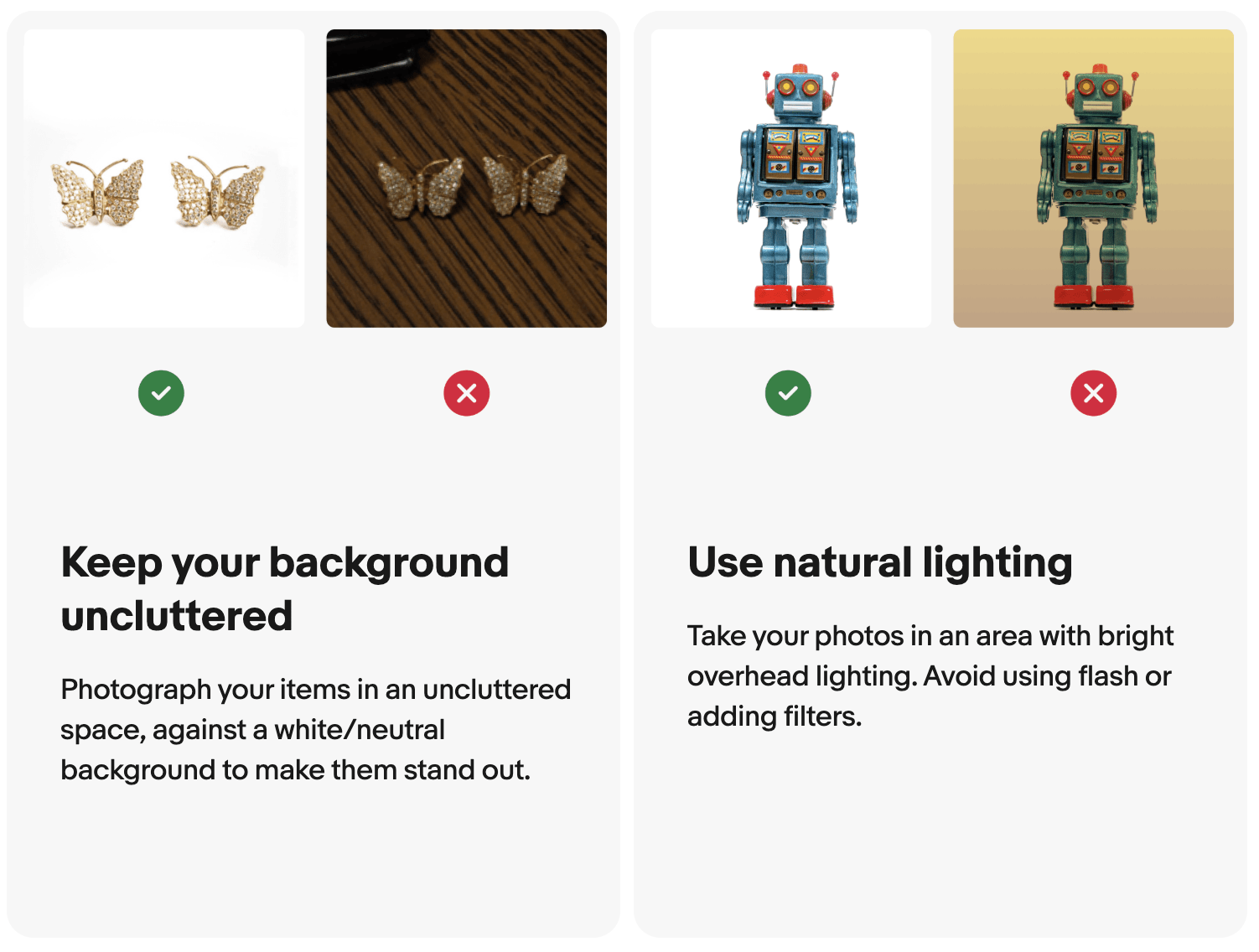
Are your photos clear, well-lit, and showing the item from multiple angles? Buyers on eBay are cautious. Poor photos create doubt, and doubt kills sales. A quick re-shoot can make a meaningful difference.
Is your price aligned with what the market is actually paying? This is the most common issue. Many resellers set their price based on what they want to make rather than what buyers are actually paying. Check completed and sold listings, not active ones. Active listings are asking prices. Sold listings are facts. Our eBay pricing guide walks through how to research this properly.
If any of these areas need work, fix them before taking any further steps. A relisted or revised listing with better photos and a sharper title has solved plenty of slow-moving inventory.
If your listing is in solid shape and the item still isn’t moving, it’s time to do an honest read of where the market actually stands.
Pull up eBay’s completed listings for your item and look at what has sold recently, at what price, and how many are currently listed. If you see 40 active listings and only a handful of sales in the past two weeks, the market is saturated. If recent sold prices have dropped below where you listed, the market has moved against you.
At this point, you need to do a straightforward calculation. Take the current realistic sell price, subtract eBay’s 13% fee and any shipping costs, and see what you’re actually netting. Compare that number to what you paid. That tells you the true state of your position.
From here, there are two possible situations.
The first is that you can still sell profitably, just for less than you originally hoped. This is the easiest outcome. Adjust your price to match current sold comps and accept a smaller margin. Getting money back in your pocket is almost always better than holding inventory and hoping the market recovers.
The second is that the math no longer works in your favor. If selling at current market prices would mean losing money, you need to decide what to do before you drop your price any further.
Before taking a loss on a sale, always check whether you can still return the item to the retailer. This is the step a lot of resellers skip, sometimes because they’ve forgotten when they bought it, and sometimes because they assumed it was too late.
If you’re within the return window, this is your cleanest exit. You recover your full purchase price, avoid platform fees, and can redeploy that capital into something with better prospects. Even if the window is tight, it’s worth calling the retailer or checking your receipt. Some stores offer extended windows for loyalty members or credit card holders.
If returning is still an option, use it. That is exactly what the return policy is there for.
If you’re past the return window and the eBay math isn’t working, local selling is worth a serious look before you take a full loss.
Selling locally through Facebook Marketplace or a similar platform eliminates eBay’s 13% fee and removes shipping costs entirely. That changes the math in ways that can make the difference between breaking even and eating a loss. An item that would net you $10 less than you paid on eBay might break even or come out slightly ahead locally, simply because you’re keeping more of the sale price.
Local selling also moves faster for certain categories of items, especially anything bulky, electronics, or items with strong local demand. It’s not always the right fit, but it’s a meaningful option to exhaust before accepting a loss.
If local selling isn’t working either, you’re now in the position most resellers want to avoid but sometimes can’t: taking a loss or writing the item off.
At this point, you have a few realistic options. Selling below your purchase price on eBay is usually the best financial move, even if it stings. Getting some money back is better than none, and completed sales contribute positively to your eBay feedback score, which has real long-term value for your account health. A buyer who gives you five stars on an item you barely broke even on is still a net positive for your business.
If the item has personal use value to you, keeping it is a reasonable call. You’re out the capital, but you’re getting something for it.
Donating or giving the item away gets it out of your inventory and clears your mental bandwidth. It’s a real cost, but sometimes the right move is to close the chapter cleanly. Donations to a registered 503(c) organization are tax deductible, but this valuation is at the item’s “fair market value,” with orgs like Goodwill offering pennies on the dollar for most items. It might be worth contacting a CPA for your options when it comes to writing off more sizable donations.
Whatever you decide, don’t let the sunk cost of the original purchase drive you to hold indefinitely hoping for a turnaround. In most cases, soft markets get softer, not stronger. Capital sitting in dead inventory is capital you can’t use for the next opportunity.
A failed flip is expensive, but it becomes less expensive when you extract a lesson from it.
After resolving the inventory, take ten minutes to think through what went wrong. The questions worth asking are more useful than they might seem.
Did you take someone else’s word that this was a good flip without verifying it yourself? Tips from group chats, social media, and even dedicated reselling resources are starting points for research, not substitutes for it. Sold comps are the final word on whether a market exists.
Did the market move faster than you could act? Speed matters in reselling. If an item was genuinely a good flip last week and saturated by the time you listed, that’s a sourcing and execution timing issue worth thinking through.
Did the item unexpectedly restock? A limited item that gets a surprise restock from the manufacturer or retailer can wipe out the secondary market overnight. This is a risk in any drop-based category, and it’s worth factoring in before committing to anything positioned as “limited.”
Did you buy the wrong variant? Wrong size, wrong colorway, wrong edition — this is one of the more frustrating ways to get stuck, because the right version of the item you bought might be doing fine on the secondary market.
The most important question is whether you accurately assessed the risk before you bought. Some flips carry almost no downside. Others are much closer to a coin flip. Both can be reasonable purchases as long as you go in with open eyes. The resellers who get burned repeatedly tend to consistently misjudge risk — not necessarily by taking risks, but by believing they weren’t taking any. If you honestly evaluated the risk before buying and it still didn’t pan out, that’s the nature of the business. Adjust your model and move forward. If you got blindsided by something you didn’t see coming that you really should have, that’s the lesson.
Every reseller has a story about the one that went sideways. The ones who are still doing this a few years later are the ones who treated it as tuition rather than a reason to stop.
This article is part of Resell Calendar’s complete beginner’s guide to reselling
This is one of the most volatile markets for resellers
From total noob to seasoned pro, we're here to answer all your questions
Be polite, be prompt, and be aware